The Golden Wrench

A blog about bicycle repair and maintenance by the mechanics at Freewheel Bike.

Sunday, December 12, 2010

Midtown Skiway

If you don't live in the Midwest, you may have heard that Minnesota experienced a record-setting storm yesterday that resulted in well over a foot of snow.  Strong winds (gusting to 50mph) turned south Minneapolis into a snowy desert with drifting dunes of snow accumulating all over the place.  Buses were called back to the garage, plows were called back, and just about everything ground to a halt.  Today the streets are still a mess, with cars buried in snowbanks as far as the eye can see. 

Our fair Midtown Greenway commuter trail, normally plowed before the surface streets nearby, is a disaster for bikes.  Fortunately, us Minnesotans have a few other ways to get around in this weather.  Myself and one other coworker skied to work today.  Here what the Greenway looked like when I came in around noon:


Here's what the snowdrift on the Greenway in front of Midtown looked like yesterday afternoon and again as we were closing up, when the drift was about chest-deep:


Saturday, December 11, 2010

drifting away


Greenway status update:  Blowing snow has drifted to 3+ feet in many places.  We've got the coffee going, and fresh baked cookies.  Don't forget your emergency survival kit.  I love winter biking as much as the next guy, but I'll be skiing to work tomorrow.

Aaron and Pete just decided that everyone who shows up at Midtown on a bike today gets a free free cup of coffee or espresso.  Not kidding!

Thursday, December 9, 2010

Looking out for #1

I made a quick trip to the grocery store this afternoon, partly because I was out of egg nog (ask me about the yuletide cocktail I invented) and partly because it was so mild out. My ride to the store was fairly uneventful, just the usual serpentine detours through snow-covered fields and unplowed sections of bike path. I got what I needed for groceries, made a side-trip to the liquor store (ask me about the yuletide cocktail I invented), and pointed my Nokians toward home.

I was coasting down a slight hill into a nondescript intersection, preparing to make a left turn, when I heard a car coming fast and close on my six o'clock. I glanced back as I altered my line to stay in the part of the lane I had already claimed and got ready to brake hard. The motorist practically squealed their tires while making a move that eventually became a right turn and that forced me to drastically alter my line and, yes, get on the brakes. In the middle of all that I somehow found time to shout some choice words at the passenger window a mere foot from the end of my handlebars. I'll forgo a direct quote, lest the children overhear.

What bothers me here isn't some abstract notion of disrespect or inequality, even though this driver clearly saw me as an (inanimate?) obstacle rather than someone with whom they needed to share the road. What bothers me is that this motorist left it completely in my hands whether I went to the hospital. If I hadn't heard them coming (from behind me, going in the same direction!) and taken action (while they were still behind me!), I would have gone under their front wheels. Instead of helping me write this blog post, my brains would be packed with snow and sodium chloride into some potholes on Lowry Hill.

What's my point? Be careful out there, people. The life you save may be your own.

Now I plan to have a couple glasses of 'nog. And I'm gonna mix it strong...

Thursday, December 2, 2010

We are now a Shimano Service Center

Here's a sign just in case you didn't believe me.


We stock a lot of Shimano tools...


...and parts.


Being a Shimano Service Center basically means that we stock a lot of Shimano parts and that we can usually handle your warranty problems quickly if not on the spot. Just remember that warranty covers manufacturer's defects, not stuff like this.

From the Inbox

We were recently contacted by a lady from Indonesia about our "capability to supply me about this products." After a few valuable life lessons, we have learned to not allow exiled princesses of tropical dictatorships to make direct deposits into our bank accounts. Boy, who can you trust these days?

-----Original Message-----
From:**********************************************
Sent: Monday, November 22, 2010 4:29am
To: info@freewheelbike.com
Subject: Order Products

Greetings,

I need to buy some products from you or your company, because it seems you have
capability to supply me about this products and I'm thinking to purchase the new
ones
for this products from you or your company.

First i need to know about your company capability and I would like to ask you a
few question:

1. Do you have capability to charge credit/debit cards as the payment method?
2. Do you have capability to ship via Fedex or UPS International to Singapore?

Please be kind to answer my questions above, and I will start shared that I need
to buy from you or your company and I also hope we could have a good business in
future day.

I'm looking forward to hearing from you soon

Sincerely,
**************
Dear Monica (Oops! I mean "*******"),

We of great thank to you for informing us with respect to the interest of you regarding our product. For you to start share that need warms the intestines of us quite briskly. They are fine, fine, product, as you have clearly discern from Singapore/Indonesia. I received intense surprise upon discovery when Singapore became part of Indonesia (your e-mail originated from Indonesia)! I keep secret quite ably. The rest of the Western world will not know that Indonesia secretly conquer Singapore due to me.

Is not our website truly akin to mythical garden of great happy where bunny-rabbits and wolfs plays side-by-side with no violent? I sit here on a vast, chair and ponder which product from me or "my" company you wish to buy. Perhaps some studded tires? No, Singapore/Indonesia consist mostly of warm. It therefore would be comedy to further say "Pugsley, hand-warmer, Lake winter boot, Salsa Mukluk, other studded tire, other other studded tire, or warm mitten?" on account of Singapore/Indonesia having jungle very much and laden with monkey. This gives me mystery then.

With respect for your questions:

Our company is capable to do many vehement deeds. We sell all sort of bike and durable good related to bike, exert custom bike fit to carcass of customer, exist as walking bike encyclopedia of past and present entities bike, fix or repair daily bicycle of indeed many styles and speed, sing and dance when no customer to detect presence, and meander briskly to locations within the Mobile Repair Unit (which ought to not drive cross ocean with present insurance). At present date, we have a special on Comprehensive Overhaul, to comprehend your bicycle entirely. You save $80, or a whopping 721039.017 Rupiah!

To the point of payment: normally we say "with great happy we take your credit card, you guy!" but only when we see the whites of his eyes (something we learn in war centuries ago). For Singapore/Indonesia, the best method of remunerate occurs when you greet us by mail with great pillowcase full of rupiah (at current exchange rate, 9,132 per dollar) and for the shipping rate. Otherwise, it would be fine good to see the whites of your eyes Monica (oops! I mean "********"). With the pillowcase in wheelbarrow I suspect.

To the point of shipment: To northern continents we would merely dispatch Nick in Freewheel Mobile Repair Unit when ice on ocean occurs good and solid. Since Singapore/Indonesia dwells in water far too temperate to ice over, the hands of us experience enfeeblement. Perhaps again, you come to arrive at us, we cheerfully accept great pillowcase full of Rupiah, and help you back to your conveyance with items. We are locate at 44.968040 degrees north latitude with 93.246466 west longitude. To find us, these coordinates make easy work in defiance of road construction so greatly ever present here where road construction occurs malodorous!

We hope that future day supplies good business in our favor, with respect to above something something.


With sincerity intermingled by compunctions,


Chris

Golden Wrench Level Six or So Mechanic and Designated (Delegated?) Answerer of Foreign Propositions

Monday, November 22, 2010

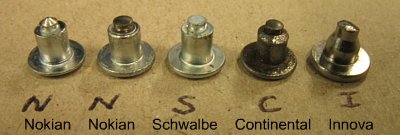
Replacement Studs for Studded Tires

Studded tires make a world of difference when the streets are coated in a layer of glare ice.  The studs, typically made of tungsten carbide, are small thumbtack-shaped pieces of metal that are held into the tire by their wider base end.  It's very common to lose a stud or two from time to time, but they are easy to replace.  Unfortunately, only some manufacturers offer replacement studs for sale.  Let's see how close of a fit the available studs are to several other manufacturers' studs:


Nokian studs
Probably the most common replacement stud available is the Nokian pointed-tip stud.  These studs are found on the Nokian Extreme models, and are only slightly different from the domed-tip studs found on most of the rest of Nokian's tires (the A10, W106, Mount & Ground, etc.)  All of the readily-available Nokian studs are the pointed tip variety.  There is almost zero difference in the dimensions of these two studs.
  • Material: carbide
  • Tip shape: pointed or slightly domed versions
  • Overall height: 5.8mm (pointed), and 5.5mm (domed)
  • Base height: 1.0mm
  • Base diameter: 6.5mm
  • Shaft diameter: 3.4mm
  • Tip diameter: 2.0mm
Schwalbe studs
Schwalbe's Marathon Winter tires are available in a number of different sizes, and all use the same type of stud.  Unfortunately, Schwalbe replacement studs are not normally available.  Fortunately, Nokian replacement studs are a perfect fit.
  • Material: carbide
  • Tip shape: flat
  • Overall height: 5.5mm
  • Base height: 1.0mm
  • Base diameter: 6.3mm
  • Shaft diameter: 3.4mm
  • Tip diameter: 2.0mm
Continental studs
The stud measured here was borrowed from a Continental Spike Claw 240 tire.  Continental replacement studs are not normally available, but Nokian replacement studs are a perfect fit.

  • Material: carbide
  • Tip shape: slightly domed
  • Overall height: 5.5mm
  • Base height: 1.0mm
  • Base diameter: 6.4mm
  • Shaft diameter: 3.4mm
  • Tip diameter: 1.9mm
Innova studs
Innova tires are usually quite a bit less expensive than other studded tires, but beware that Innova uses an inferior material for their studs.  Instead of tungsten carbide, Innova's studs are made from plain old mild steel.  While they are less expensive to produce, steel is significantly softer than your average pavement surface, and the studs literally wear down over time if ridden on bare pavement.   The expected lifespan for these studs can be less than one season in many cases.  Innova studs are readily available, but are not a good choice for replacing missing carbide studs from other manufacturers for durability reasons.  Despite the slightly different dimensions, these studs should be close enough in size to be interchangeable with all of the other studs measured here.

  • Material: mild steel
  • Tip shape: irregular, rounded-off tip
  • Overall height: 5.4mm
  • Base height: 1.1mm
  • Base diameter: 6.9mm
  • Shaft diameter: 3.8mm
  • Tip diameter: 2.5mm

The bottom line is that all five of these studs should be interchangeable with one another.  If you're missing a few studs from your Schwalbe or Continental tires, the readily-available Nokian studs should be a perfect replacement.

The only major stud not available for measurement were those used in Kenda Klondike studded tires.  If a Kenda stud comes my way, I'll add it to the list.

Sunday, November 21, 2010

Proprietary Stuff to Make You go Faaaaaast


Image swiped gratuitously from Trek's online catalog. 'Tis a fast-looking beast, is it not?


Ready to rumble. We've got a bunch of them: come check them out!


Recently I spent a few days setting up our fleet of Trek Speed Concept time trial and triathlon bikes. This was my first time handling some of this technology and I was highly impressed with much of the execution. They really are amazing pieces of machinery: the engineers over at Trek eschewed off-the-shelf componentry in favor of an integrated approach for brakes, internal cable routing, headset, etc. The result is a bunch of proprietary stuff that requires some re-learning and exploration.

You know, the kind of stuff that gives bike nerds the happy.

The rather inefficient seatpost clamping device. Proper torque is very important because there's only a small aluminum cam holding your seat at the correct height. Carbon assembly paste works wonders here.

One thing is for sure, no matter how far-out the design happens to be, it is going to work within the parameters of a few rudimentary mechanical principles. Maybe there are no bearings in the headset: the blasted thing still has to rotate, right? And it still takes some sort of preload, right? One can hope so. A cable goes into the brake, pulls on something, and the pads contact the rim: got it. So what if everything is hidden mysteriously inside a sinister-looking plastic shroud and the cable disappears into the down tube? It's just a brake. [Incidentally, it's very much like Charlie Cunningham's Roller Cam brake from 1986] So we can make it work, and if the manufacturer's info is good, we can make it work perfectly. And if it doesn't work perfectly, we can get the parts to make it work perfectly.

Quick headset adjusts just got a whole lot slower.


The headset sort of lives under that top cap. Sort of.


The rear brake is bringing back the Darth Vader look for 2011.


Here's the rear brake as the wind sees it.


The mechanic has to wave his fingers around near the razor-sharp teeth on that chainring when making quick brake pad adjustments.

Here's where things can get tricky: If Trek stops making the parts, what then?

Some fly-by-night companies release cutting-edge stuff, only to discover that cyclists break things and want them fixed, sometimes for free. More than one upstart business has been killed by warranty issues, often caused by skimping on R&D and real-world testing in favor of releasing the product quickly. Then stuff starts to break, or doesn't work right, or gets a bad reputation on internet forums (probably the last place you should go in search of wisdom and insight), or whatever, and the company folds up. Usually they retreat into the shadows and regroup, focusing on things like dentrifices, banjos, Arabesques, ice floes, briskets, arthropods, obelisks, flautas, decorative gourds, and sippy-cups. We wish them the best, of course, but we also wish that they would support their bicycle-related products with spare parts.

I'm going to go out on a limb and say that Trek won't do anything like that to anyone, but they have had their share of mercifully short-lived ideas. New technology is like that: sometimes it works in the real world, sometimes it doesn't.

Overall, most of the ideas on the Speed Concept bike make good sense. The rear brake is a robust unit, made out of real metal, and crazy easy to set up once you get through the force field of tiny bolts and plastic. The cable routing for the shifters and brakes only allows for about 90 degrees total (45 per side) of steering rotation, but I doubt too many people are going to bust out a trackstand at a stoplight on a Speed Concept.

I noticed right away that Trek called it "Speed Concept" rather than "Race-Day Mechanic's Dream Concept." These things are designed to go faaaaaast. Cables flapping in the wind, round handlebars, brakes out where you can adjust them--that stuff's not faaaaaast, it's pedestrian. The Speed Concept bikes are designed for a world where a tenth of a second is a long time, and the concessions they make in convenience are purposeful.
This is the "Lunchbox." It is not UCI legal (as Kevin discovered at the Tour of California), so if you want to bring a sandwich or some Fig Newtons during the prologue at the Giro this year, you'll have to tuck them in the front of your skinsuit.


Still, I'm glad I'm not a team mechanic having to fight against the clock with the infernal (oops! I mean internal) cable routing or last-second rear brake adjustments, but usually the pro teams bring a bunch of "just in case" bikes to any given event. For the regular human beings who will be buying these, make sure your brakes are set up the day before, and be careful not to kink a cable right before your event!

Monday, November 15, 2010

Winterizing a Snow Bike

Fall is the best time of year to give your bike a overhaul for a couple reasons.

If you are putting a bike away for winter storage you'll want to get the water out of the internals where it can cause rust throughout the winter. The other benefit is that your bike will be ready to ride when spring arrives. Plus you'll save money because most shops run an overhaul sale in the winter.

If you are riding your bike all winter then you'll want to get a low temp grease in the bearings and free-hub body, maybe install studded tires, and rust proof steel frames.
This poor Pugsley has been ridden and raced hard yet received very little maintenance. We gave it a Winter Overhaul about a month ago to make sure that it was ready for the first snow fall of the year.


Rust was starting to eat away at the fork...


...and frame...


...so I applied JP Weigle Frame Saver


Next the drive-train got cleaned up in our
environmentally friendly parts washer.


I applied anti-seize to the bottom bracket shell threads
to prevent galvanic corrosion.


Then I faced the head-tube.


Now it looks like this.


The brake posts got plenty of grease.


The derailleur pulleys were removed, cleaned and
lubricated.


This Pugsley has rear hubs in both wheels. Both got
repacked with Morningstar 'Lectric Lube


And of course the free-hub body was purged and filled
with 'Lectric Lube.


'Lectric Lube grease remains the same consistency down
to -50f so you don't get any drag when riding in really
cold temps.


Freewheel Bike's Winter Overhaul Special includes everything from our regular overhaul then the price is reduced by $80 plus it includes free pick up and delivery.

Friday, November 12, 2010

Counterpoint: Rock Shox XX Review

Earlier this summer we had the privilege of sitting in on some Rock Shox suspension training with a few fellows from Marzocchi. No--Rock Shox. Yes, that's it. Anyways, I had endured a few bad experiences with Rock Shox suspension back in the day (a leaky, fragile first-generation SID) and had pretty much written them off as a bunch of snake-oil selling Hessians (no offense to any Hessians in the wide scope of Golden Wrench readership). My junk-o-meter was set to stun when they began to tear apart the demo fork for our learning. I scrutinized every piece they passed around, expecting a bunch of spindly ribbons of tortured aluminum, doohickeys, religious totems, ventricles, and Clif bar wrappers to come out of the damping side. Nope, just a couple of assemblies! I was surprised by the simplicity of their damping system, and especially by their platform: it's a plastic spring that controls a blowoff port. Everything in these forks is modular: they are a breeze to work on.

What really intrigued me was the X-Loc feature found on the XX forks. We had done a piece for the MORC newsletter on how to bleed and set up the X-Loc, and it's a pretty thoughtful design. No cable drag or huge spring tension to overcome cable drag: just liquid-smooth hydraulic goodness. On, off, adjustable floodgate. The simple-minded can call it witchcraft: I think Bernoulli and Newton would be proud of its simplicity and effectiveness. Furthermore, I can't wait for a rear-shock counterpart, or one hydraulic switch that will control both front and rear! Or an electronic damping system that responds to my feelings as long as I don't ride too close to a microwave tower or drain the battery! Oh wait--K2 already did that back in the day.

Anyways, I sent off for a Rock Shox SID XX with an aluminum crown. About 8 hours later, it arrived from QBP, complete with the fork itself, an enormous cardboard box decorated in a fetching shade of blue, several layers of plastic bags, a shock pump, ONLY ONE BLASTED STICKER AND NOT THE SWEET DECAL KIT (!??!?!!??!?!?!!!??!?!), and a manual. Also included was a travel reducer to shorten the stroke down to 80mm, which will probably never see the light of day after it was deposited in my junk drawer. Initial impressions were positive: it's a modern and attractive white color with gray graphics; it's smooth (better be, right?); it's not horribly heavy; and that lockout is the cat's pajamas.

After a few weeks spent scaring up the funds to actually pay the thing off, I still was able to ride the fork for at least four weeks before some other guy at the shop had heard anything besides "Stop calling us, man, or it will take longer, man" from a certain company out west. That company will remain anonymous, but the clever among us will recognize that it is named after a scavenging mammal that gains its sustenance by raiding the nests of game fowl.

I slapped the fork onto my trusty old Gunnar Ruffian (having crashed and bent the previous fork at the Murphy TT), filled it full of air, mounted the lockout on the left side, and tried it out. The front wheel was doing things I was not accustomed to, such as tracking straight through rough terrain and holding a line in rough corners. I would lock the fork out on the road and when climbing out of the saddle, but then I would forget to unlock it. That's OK, because in addition to about 3/4" of super-progressive travel (even with it locked out) you can adjust the "gate" feature and make the blowoff ports open sooner. After a couple of forgetful episodes, I dialed down the gate so the fork would open up sooner, sparing my pore ole wrists. It's a platform, yay!

After some test riding (which included the Border Battle race, as good a test ride as one will find), I moved the lockout to the right side, under the bar. Single speed, no shifters, plenty of room. Since the lockout button was in the place that a RapidFire shifter would be, I referred to it as my "climbing gear." Soon I was hitting the lockout every time I got out of the saddle at all, and my "climbing gear" became a "road gear," a "sprint gear," a "trackstand gear," and a "flat, smooth trail gear." That lockout gets a workout and hasn't leaked, slipped, cried, gurgled, cheated on its taxes, pestered my dog, or written any bad poetry since I bought it. Not yet anyways.

Nowadays, the Gunnar is doing cyclocross duty and the Rock Shox XX is on my old Trek Fuel, AKA "Mister Sloppy." Changed that bike around, I tell you what! It came with a Pure DeLite SID that was flexy and noisy and gross, but with the XX old Mister Sloppy rides like a KX 125. It took a few rides to get used to the handling, going from 80mm to 100mm of travel, but after flipping the stem and messing with spacers, Mister Sloppy descends with some confidence.

Objection: Yes, and OK, you mister guy, but wouldn't it be better to ride a platform fork that locks out for you?

Answer: Sometimes I'd rather not have to wonder if my fork is locked out, such as when I'm going to bunnyhop over a log. Or, if I'm in competition and sprinting on rough ground, I want the front to feel rigid, even at the potential expense of some shock absorption. As for the lockout learning curve, I hit it without even really thinking about it: If the trail is smooth, I lock it out. If not, I unlock it. So convenient! Sometimes I even hit the lockout in the air for a cushy landing when I jump over things!

Objection: Yes, and OK, mister guy, but haven't you had to mess with it a bunch since you bought it?

Answer: Not really. As far as setup is concerned, the factory recommendations have been fine for me. I initially ran the air pressure on the high side of things, but now that I use the lockout so much, I'm running it softer. I've had to add air to the positive spring one time since August. I've never touched the damping dial: it's about 1/4 of the way from full rabbit.

If you're in the market for a new fork, definitely give the Rock Shox line a look. They're not winning the OEM game these days (russet-colored scavengers), but they still produce some fine performers for Minnesota-type riding.

Wednesday, November 3, 2010

What do you mean my chain "stretched"?

Bicycle mechanics often refer to a worn out chain as "stretched". It sounds a little weird to think of a metal chain stretching so I don't blame you if you're a bit skeptical of this statement. When we say a chain is stretched out we aren't saying that it is like a rubber band that has been stretched out too long and won't return to it's original shape. It would be more accurate to say the chain is elongated. What is happening is that the distance from pin to pin has increased.


Here is a picture of a chain wear indicator on a new chain. Note that it reads 0.04mm. That would be a happy chain.


Here is a stretched or elongated chain. The tool reads 1.73mm. That would be a sad chain.


As you can see from this picture there are two grooves in the chain pin that correspond to the inner plates of this chain.


That wear occurs only on the side of the pin that experiences load.


The grooves can get quite deep.


A worn chain will wear out the teeth on the cassette and chain-ring(s).

Worn teeth can lead to things like chain suck, slipping under load and poor shifting. A worn chain is also more prone to break. If you replace your chain before it is worn out you can almost always avoid these problems and actually save money.


Be the first to correctly answer the following trivia question and win the Park Tool CC-3. E-mail answers to peteh@freewheelbike.com.
If using a ruler to measure chain wear, how much can a chain stretch (in inches) before it is considered worn out?

Edit: We have a winner. The answer is 1/16". Thanks for playing.
Here are a few links if learn more about measuring chain wear with a ruler;
http://bicycletutor.com/chain-wear/
http://pardo.net/bike/pic/fail-004/000.html
http://www.epicidiot.com/sports/chain_length_calculator.htm#stretch
http://en.wikipedia.org/wiki/Bicycle_chain

Friday, October 22, 2010

The Performance Trap and How I Escaped

The allure of more speed... No--let's say it like it needs to be said: The allure of more speeeeed.... This is how I justify many of my bicycle related purchases. The thought process looks something like this:

Self: "I have just received a paycheck from my employer. Time for an upgrade."
Bike: "You know, you'd be faster if you just rode more and ate less."
Self: "Hush your noise, you!"

So I look at my bike, the Gunnar Ruffian CX Hybrid (Don't tell Richard Schwinn I did this). It looks like this:


The trained eye of the Golden Wrench readership will quickly spot the glaring defect in this otherwise harmonious machine. No, I intentionally put 700c wheels on a 26" bike, I'm talking about the other defect.

CORRECT! DINGDINGDING!!! THE GRIPS!!!

Those particular grips had hit just about every tree on the Theo Wirth loop. Plus, they're ESI silicone, so they do wear out eventually (long after they stop smelling like Silly Putty). They were ripped, shriveled, stretched out, perma-stained, and frankly, a bit smelly. So it was time for a change.

I started by installing a narrower handlebar and a stiffer stem, which ended up taking about 70 grams off the front of the bike. Rather than bring the tired ESI grips out of the basement graveyard, I thought I'd go pro and wrap my bars with road tape.

Wrapping Flat Bars with Road Tape: Pros and Cons

PROS:
1. Yeah! Awesomeness! I have seen other people do this, and they happened to be awesome!
2. Light! I will be high performance super-guy and probably beat people only because of my road tape grips!
3. Colorful! Children will learn my name and cheer for me at CX races!
4. Cheap! Leftovers!
5. Light! I will only with difficulty keep the front wheel on the ground!
6. See #2, #5 because they are the primary reasons, and really all I was concerned about!

CONS:
1. Sends shooting pains up from hands to shoulders in rough terrain (which is everywhere, I soon discovered)! Yay, now I can easily detect rough terrain!
2. Tears easily! Yeah! I get to do maintenance on my GRIPS!
3. Colorful until dirty! The children actually began to cry because they thought I was a bum on a bum bike, but their parents gave me some money, so it wasn't all bad!
4. #1 is an awfully powerful consideration! My hands really hurted! I could not shop for groceries with a cart without fighting back tears!
5. Will not stay put, even with extreme measures, such as double-stick tape, electrical tape, arc welding, staples, threats, ocelots, mermaids, brown sugar, two eggs, a teaspoon of vanilla, a cup of whole-wheat flour, and a ripe banana. Bake for twelve minutes at 450 degrees, or until a nice crust appears.

In other words, it was the worst mistake of my adult life. Worse than paying full retail for books that are public domain on Google Books now.

Oh hands, I was wrong: will you forgive me?

Well, this relationship was going nowhere in a hurry. It was time to be done with it, but for some reason whenever I visit the grip rack at work in my own self-interest, the token pair of ESI grips that we stock (black of course) is always sold out. So then I have to make a decision: order some new ones in a ridiculous color that matches nothing, such as Kermit the Frog Green, or continue to damage my hands until they are non-functioning pork chops at the ends of my limbs. The first will make me wait a week, the second would render my hands useless because I don't like pork.

*PFFFFFFFFFFSSSHHHHH!* *PFFFSSSSHHWEEEEEEEFFFFFFERP!* *PFFSSHHH!* *eep* *PFFFFSHHFFFSSSHSSFFFFFSSSHHHFFFFSSSSHHHOOONNKKKK* *FERP!*

The above sounds were coming from around the corner, where Jason was installing a brand new set of Oury grips on his bike. His old Ourys, after two seasons, looked like new except for rips in the ends. Apparently, some other employees at Freewheel would put 1/4" bearings inside his handlebars through the little rips, and Jason's ride home to St. Paul would sound like *tinkitytinkitytinkitytinkity*. Jason's a rather manly dude, and would not have his bike go *tinkitytinkitytinkitytinkity* if he could help it, so he ordered up some crystal clear Oury grips to deck out his hypo-commuter. There are currently no rips in the ends of these grips for his evil coworkers to put bearings into (so we will have to take out his seatpost and put them in his top tube, I guess).

His old Ourys laid on the bench all sad-like saying "It's not our fault that your coworkers are evil! Look how well we've held up for all these years." They played the sympathy card really well, I must admit. I've always thought that Oury grips were ugly: they looked like something from a claymation motocross something or other. Plus, they seem to appeal to people with gorilla hands, where mine are more like rhinoceros hands (big with comparatively short fingers). I've also been told that they're for people with arthritis. But there they were, all sad and lonely. My hands still hurt from the ride in to work, all bunnyhopping curbs and catching air and stuff. I was ready for a change.

I asked Jason if I could borrow them and try them out on the Hybrid. He said "sure," or at least he loosed a well-crafted sentence at me that led me to believe that he meant "sure." Hopefully he meant "sure" because I don't want to go to jail. I installed them after work and rode home.

Now I have HAPPY HANDS! They just can't stop dancing! Anywhere I go, my hands start dancing like fools. I have to sit on them or put them in my pockets or bite them when I'm in public. Mostly because I'm of northern European descent and dancing just ain't our thing so much as pillaging and looting, but also because dancing hands often leads to institutionalization, and I have too much going on in life.

I was so excited to not have my hands turn into porkchops on the ride home that I checked out Oury's website! Wow, it sucks! But their grips make my hands dance! So I forgive them!

Wednesday, October 13, 2010

Goodbye Andy Paradowski from Hayes


Word has been spreading quietly amongst industry insiders about the death of Andy Paradowski from Hayes Brakes. You may remember him from a couple of our older posts;
Getting Smarter

Please Try Not To Get Oil On The Carpet
Andy was a dedicated bicycle mechanic and all around good guy. Our hearts go out to his family and friends.

Andy is the guy on the right in the Hayes work shirt.

Tuesday, October 12, 2010

Thank You

Thank You, such a simple thing to say yet it can leave a lasting impact on a person's outlook. I have been noticing something around the shop that has driven home just how important is to give and receive thank yous. The following photos are pictures of some of the thank yous that we have received over the years. They have obviously made an impact on us because we not only keep them (sometimes for years) but we often display them at our work areas.


These are thank you cards that Patrick keeps above his workbench at Check-In.


This is a letter that I kept in my tool box.


I noticed this letter in Stephen's office. It's from a customer that bought a new bike and found that the fit needed to be tweaked to more closely match her old bike.


This has been in Kevin's office since I started working here about two years ago.


This is my favorite. There is a wall in the back of the store with where a bunch of Scout Troops wrote their thank yous to Marcy. I assume that she was teaching bicycle repair classes so that they could get their merit badges. Some are dated as far back as 1991.


This is a post card that Tyson keeps above his bench. Apparently Chairman Bob approves.


Most letters come via e-mail these days. I keep a folder of them.

This post is not meant to brag about how great we are because the truth is, we do get some complaint letters too. While we don't like getting complaints we do appreciate when people make the effort to give us constructive criticism and a chance to redeem ourselves if needed.

So I'd like to say, Thank You, to all of our great customers. You are the reason that we love doing what we do.

Thursday, October 7, 2010

Annual fork service. Annual fork service. Annual fork service.

Guess what my topic is today? That's right! Annual fork service. Annual suspension service, really. In all my work with suspension components, I occasionally see horrible, terrible, preventable things like this:


...and it breaks my heart. This fork is essentially ruined, simply from neglect. Just look at all that dirt on the wipers and foam rings! And see how that dirt put huge scratches in the stanchions!

The job of those gray wipers (which you can see on your fork where the upper legs, or stanchions, disappear into the lowers) is to keep the dirt out and the oil in. But they can only do so much, and over time dirt works its way past them into your fork internals. If left there long enough, it can cause damage to the stanchions themselves, as seen above. Even with new wipers and a lot of cleaning, this fork will leak oil and ingest dirt at an accelerated rate because the wipers can no longer form a tight seal against the stanchions. Had this fork received regular maintenance (annual service!) it would be full of fresh oil and back out on the trail already. Instead it's going in the scrap heap.

So please, people, bring me your forks (and shocks) so this doesn't happen to you. Different manufacturers recommend different service intervals, but let's go with something simple: have your suspension components serviced once a year. They will last a long time and work like they're supposed to. And it will be good.

Speaking of which, the other week I got the chance to work on a fork that you don't see a lot of around here. One of our customers brought in a Rock Shox Lyrik complete with Mission Control damping and 2-step (travel-adjust) air spring! With the twist of a knob this big boy goes from 160mm of travel (for descending) to 115mm (for climbing), and back. Think of it as Rock Shox's version of the Fox TALAS fork. Check it out:


...and that's just the air-spring side! On the damper side we have separate low- and high-speed compression adjustment and position-sensitive rebound damping. Fun stuff.

So remember: Annual service. Annual service. Annual service.

Thursday, September 23, 2010

Technical feature!? What technical feature? You mean that slightly rough section back there?


Suspension has been taking up a lot of my time lately. Riding it, working on it, trying to save money to acquire it...

For the last few years I've been riding a couple versions of Rock Shox's venerable Duke fork (30mm stanchions, outdated damping, miniscule travel). Back in the early part of this century this was a ground-breaking fork, but we're a decade into the 00's, and I was in need of an upgrade.

So back in July I pushed all my money into a pile in the living room and figured it looked like enough for a new fork.

But it couldn't be just any fork. The problem (and fun!) with working on everybody else's suspension components is that I get to see all the insides. I see the fancy stuff, I see the entry-level stuff, I see the ideas that didn't really work, I see the brilliant engineering solutions for complex problems. And I see the stuff coming out of Watsonville, California. I'm talking about Fox Racing Shox here.

Lots of people have lots of good ideas about how to make suspension forks that get the job done, and there are plenty of forks out there that will perform great on the trail for way less money than a Fox. But if what you're looking for is the silkiest, plushest, most ground-hugging, most fine-tuneable suspension on the market, Fox is it.

But I'm not the only person who thinks this. So if you're in the market for a Fox fork, be prepared to wait. I did. I waited two agonizing months. That's most of our riding season around here! And yes, Fox's stuff is expensive. But back up a couple paragraphs and you'll find that I already explained that. And let me tell you from first hand experience that my new fork was worth every second of waiting and every penny I spent.

My weapon of choice was the 2011 F100 Terralogic fork with a 15QR thru-axle. I was taking a gamble here--Fox reintroduced their Terralogic damper just this year, after pulling it from production in 2007 because the earlier versions weren't performing to expectations. But I had a feeling, similar to the one I had back when I bought a Burton Alpine and a season pass to a local hill before I'd even once ridden a snowboard--I just knew it was going to be awesome. And I was right both times.

Let me stop for a minute and explain what Terralogic is: Most of you are familiar with the ability of suspension forks to "lock out," usually by spinning a knob on the top of the right fork leg (some of you even have handlebar-mounted remote levers for this). This prevents the fork from compressing while sprinting or climbing, minimizing pedal bob and allowing for maximum acceleration. When you want the fork to go back to soaking up bumps, you spin the knob back to the "off" position.

This is a great feature to have, but here in the Midwest there aren't many places with sustained climbs. Most of my favorite trails have constant minor elevation changes and are more like a roller coaster than a luge track. That's an awful lot of knob-fiddling to turn the lockout on and off every 30 yards. And this is why Fox's Terralogic system is a miracle.

Built into the damper cartridge is an inertia valve (a large-ish piece of brass) which in smooth conditions keeps the compression circuit closed, so the fork is locked out. When you hit a bump, the BrassMass opens (an object at rest...), allowing the fork to compress like a non-locked-out fork. When the trail smooths out, the mass settles back into its closed position, and you once again have a locked-out fork.

I had my doubts in the parking lot, when it felt like I had two different forks on the bike depending on whether I was riding in the flat or hitting the speed bumps. But once I got out to the trail, the fork disappeared (I mean this in a good way) and I was riding faster than I ever have before.

Braking bumps disappeared, obstacles got smaller, corners got stickier, skinnies got wider and getting out of the saddle to hammer on the pedals no longer caused the front end to bounce and wallow. The transition between open and locked-out (and vice versa) was seamless and instant. No lag, no initial harshness, no confusion. Solid. Amazing. Miraculous.

Part of the improvement is definitely due to the 15mm thru-axle, which reduces front-end flex and make steering more stable and precise. Part of it is the extra 20mm of travel over my old fork, giving me more cushion to soak up the rough stuff (I was worried the extra travel would make my steering slower because of the slacker headtube angle, but for some magical reason this isn't an issue). Part of it is Fox's FiT damper, which is supple beyond belief. Oh, and don't forget the new super-slippery Kashima coat on the fork stanchions, which improves small-bump compliance and supposedly also improves durability.

In short: Awesome. Amazing. Worth the wait. The only downside is that I have to try harder to push the fork to its limits, meaning I have to ride faster, meaning I have to pedal more, meaning I'm a little sore today. And tired. But happy.

...this is all a long way of saying that we're currently offering a special on all suspension labor through the end of October. So stop by and give your fork and/or shock the love it needs (annual service!) while it's cheap.