The Golden Wrench

A blog about bicycle repair and maintenance by the mechanics at Freewheel Bike.

Sunday, April 17, 2011

Campy Freehub Install

The hubshell has been cleaned and lubricated.


The pawls have been cleaned and reinstalled.


Hold the pawls down with the Campy spring tool.


Slide the freehub onto the axle.


The spring tool keeps the pawls down allowing the to be inserted into the freehub.


The tool can the be removed and the freehub inserted the rest of the way.


Wednesday, March 9, 2011

How Grease Works! (as far as we know)

The guy who cuts Clark Kent's hair probably doesn't have a clue, even if he happens to look down the collar and see the red and blue skinsuit. "Long johns," says the barber, dismissively, then goes back to snippin' and stylin'.

I would never have known that one of our Supercustomers makes tiny little gyroscopes that guide aerospace equipment. You know, like space ships and time machines and fancy electro-transistor huckaloogies that cost lots and lots of money and are not terribly useful for gardening. Meet Andrew Paule, the Physicist.


Not surprisingly (if you know aerospace guys), he's riding around on a set of Campagnolo hubs from 1968, and they're flawlessly smooth. He also has "Dr. Feelgood" as the ringtone on his phone, so we're absolutely sure he's a real human being.

Andrew was impressed with our commitment to the Midtown Greenway and wanted to return a favor, so he agreed to do an entire presentation on lubrication and how it works. So we met after hours on a Saturday evening and talked about grease and bearings and oils and failure and success and why old Campagnolo hubs are so awesome, and why MOPAR-based vehicles should be avoided.

Excuse me, Andrew? How does pizza grease do in the ASTM D2266 test?

It's all theory, of course, and we all know how to be responsible with theories!

Admittedly, for starters, I'm kind of a nerd. Admittedly (and admittedly, it's easier to admit the foibles of others), Freewheel has a few nerds as mechanics, as well as a few guys who don't think they're nerds but may want to check on that. Either way, some of us really enjoyed this presentation. Let's just say that Andrew was pulling the microscopic curtain away and revealing what happens at the nano-level in the highest-stress areas on your bicycle.

It's spooky.

The races on this spindle look perfect, but under a microscope...
Once we were able to wrap our minds around what he was saying, what Andrew shared confirmed many of our sneaking suspicions: many of the products we use on our bikes amount to marketing flummery and snake oil. Here was a chance to take the mythology out of lubrication and let science clarify the matter!

Ha!

It turns out that science is a capricious servant: the truth of the matter was stranger than the mythology.

Grease is essentially just an oil with a thickener and some other additives to help it stay in place and smell awful, and Andrew explained that this puts it into the category of non-Newtonian fluids (think corn starch and water, then think about this before you cough up the money for this). Thus, grease exhibits different characteristics under different stresses. Under the extreme, localized pressure of a ball bearing against a race, awful things happen at a microscopic level, and that's why you get hub cones that look like this:

For the love of Grandma!

Yes, even a greased hub can do this, kittens! It turns out that grease, under the tiny contact point of a ball bearing against a race, can be harder than the metal in the tiny little universe inside your hub! So actually, the thing that is usually deforming is the bearing itself: the grease is just there to make sure that while the bearing deforms it can't weld itself to the race. Apparently it gets really hot when all the microscopic peaks and valleys in your mirror-smooth bearings and races articulate against one another.

It all seems so wrong!

That's why we put dust shields on our hubs: so that the little universe where everything is wrong can't come out and confuse us all. But Andrew the Physicist tells us there's hope.

Some greases, it turns out, resist the above effect better than others. The best ones cost hundreds of dollars an ounce and are used to make satellites go "beep beep beep" across the night sky and drop your cell phone call. Stupid robots.

This stuff costs well over $1000 per liter.
It is impossible to take a non-blurry picture of it.
It is safe to drink.
You first!
Most of the greases used in the bike industry are pretty mediocre according to Andrew the Physicist, but due to the relatively low speeds, this isn't nearly as big a deal as it would be, say, on a dragster. The greases we use all do a great job of inhibiting corrosion and slowing down the galling process, but most are not the greatest on the ASTM D2266 test. Does that mean they suck? No, they're totally adequate for bicycle applications, and may even excel in some specific uses. They just don't meet the absolute highest standards reserved for stuff like dentist drills, watches, interocitors, flux capacitors, and Twiki.

I was delighted to hear that we had some real standouts on our shelves however, and I will definitely prioritize those greases from now on when I do overhauls and bearing repacks.


Trivia Question: what is the official title for a scientist who studies friction?

First to respond correctly as a comment to this post will win a tube of each of our two highest-scoring greases according to Andrew the Physicist!

The top-scoring greases on our shelves: the venerable Finish Line Teflon, and the relatively new and mysterious Morningstar Freehub Soup!

They can be yours, if you're smart, resourceful, or lucky, or some combination thereof!

*Be sure and leave your e-mail address so we can get your prize to you!*

Edit: Thank you for all of the responses. Because your e-mails are included I will not publish them. The winner is Montesano! You can stop by our Westbank location anytime to pick up your prize.

Sunday, March 6, 2011

SRAM Technical University

A few weeks back, 4 of Freewheel's ace mechanics attended the SRAM Technical University to learn a few things about Avid brakes, Rock Shox forks, and some of the new SRAM shifting technology.


We all piled in our trusty Subaru Outback and headed west towards Colorado Springs. 13.5 hours later, we had arrived. Woke up Tuesday morning to a spectacular view of the mountains, and an excited state of wonder, looking forward to learning more skills to serve you fine folks better!


First day was the Avid brakes. We learned alot about the proper way to set-up the brakes for a better feel at the lever. We also learned the proper bleeding procedure to make the brakes feel amazing. (We even have a fancy new bleed kit to make things a little easier.) Alot of interesting technology goes into these brakes. The way you can adjust the levers, and the brake master cylinder to improve performance and feel. We also learned about their old brake systems and the changes they made to make them even better! And the nice thing about SRAM is, they are willing to take responsibility for their mistakes. Then they re-engineer the product. Now that's commitment.

Wednesday and Thursday were dedicated to Rock Shox suspension forks, and rear shocks. Now the stuff gets really cool! We started by tearing down and re-building a Tora front fork. Even at the "low end" there is some real technology associated with this fork. The way they engineer the air system is quite simple, but very effective at making the fork work properly for each rider and each trail condition.


When we re-built a Monarch rear shock, I admit I was a bit nervous about tearing into an air sprung rear shock. But, after about 2 minutes my fears were laid to rest. It was quite simple to maintain and overhaul! Not many people think they need to maintain their suspension systems, but after miles of abuse on the trail, things can easily wear out without routine maintenance. It's kind of like an oil change for your car. The longer it goes without service, the more likely it is that serious problems and performance issues will arise.


We also had the privilege of working on some of the high-end Lyric and Boxxer world cup forks. The Lyric was simply amazing! The 2-step air system is super cool!
The Boxxer world cup fork is quite a sight. It looks very similar to a motocross fork, just a bit downsized. Man, this fork is super sweet! The new solo air system, improved damping, and it's still pretty light for a DH fork!


We all learned alot, and had a good time doing it. We had the fortunate opportunity to meet new shop people from all over the country, and talk directly to the people who can influence what we see in the future of bike parts and technology. It's good to know we have the full support of a company dedicated to best in performance and customer service. SRAM is still the best with customer service. If you have a problem with any of their components, they want to know about it, and they will do everything in their power to help you.


We also talked briefly about the new and dramatically improved 2X10 system. The way the front chainrings are designed makes the shifting almost instant. No more waiting a half pedal revolution just to shift from the big ring on down. The new Apex road group is pretty interesting as well. It's made to compete with the Shimano 105 group. A lower price point without sacrificing performance. And it's all black!


Thank you David and Chuck at SRAM for sharing your knowledge and sense of humor. I know we all had a blast learning about your product. Also, thanks for the beer and wings! Next time you're in town, the beers are on me!


Remember to get those forks and shocks in for a oil change, or complete overhaul before the spring rush! We are fully qualified to work on all makes and models! Don't be the guy on the trail holding up the group! The mountain lion may just catch up to you first! A properly tuned suspension system makes your bike faster!

Tuesday, February 1, 2011

Would you like to be a Golden Wrench?

If you've ever wanted to be a professional bicycle mechanic this is your chance.
Freewheel Bike is hiring.  Click here. for more information.

Saturday, January 22, 2011

Paradiso or Purgatorio?

Recently my wife and I took a long-planned trip to Kauai, the northernmost and least-inhabited among the Hawaiian islands. Feel free to resent me, but if you are the resentful type, be comforted that they experienced some rather low temperatures and it rained over half the days we were there. This made the forty plus miles of hiking we did a muddy ordeal, but we left with nearly every box checked in our to-do list. I was surprised how nice it was to hike in the rain when it’s nearly 80 degrees: hiking to a waterfall in the rain in January in Hawaii is tough on socks but easy on the eyes.

One of the items on my to-do list was to rent a mountain bike and ride some trails. Most of Kauai is uninhabitable, but between the locals and the State of Hawaii, a substantial network of trails and dirt roads weaves through the hostile terrain. Why hostile? First, it’s a volcanic island, so it’s composed of basalt and pumice with a layer of dense, brick-red clay on top of it. Second, Mt. Waialeale resides in the center of the island, and the warm trade winds sweep up and drop 400-600 inches of rain per year up there.

Mt. Waialeale, from the trail

The water runs off the basalt, saturates the goopy clay, and supports an Edenic garden in shades of green that rival the stars for number. The hills and valleys are impossibly steep, choked with impenetrable walls of ferns, shrubs, fallen trees, and mud pits, and there are streams everywhere that swell to torrential floods with very little warning.

This was the EASY way on a hike we did earlier in the week

Sounds like a great place to ride a bike, right, especially when it has been raining for two days straight? That’s what I thought. So I toodled over to Kauai Cycle in Kapa’a and rented a bike. I walked in the door and somebody said "Howzit," a pidgin term similar to "Bonjour" but with less snooty-tooty. I nearly replied "Howz what?" and gave away that I'm culturally insensitive because I didn't get to the part of the guidebook where they tell you how to respond to "Howzit" politely. I think there's some sort of gesture and a specific grunt. Instead, I got right down to business.

In their flyer they advertise a hardtail for $30 a day, a road bike for $30 a day, or a full-suspension bike for $45 a day. When I arrived, the hardtails were Specialized Hard Rocks, the FS bike (they only had one) was a Specialized Rockhopper FSR (or something like that), size small. Then they had some halfways decent bikes in a separate rack, but those ones were $60 to rent because they were demos. Hmm… no mention of that in the flyer, but oh well.

I took the bait and switch and rented a Stumpjumper Comp 29er. My other options were an Enduro and some freakish DH looking thing that looked like it had blood on it, so I went with what I figured is at least reputed to be the latest greatest thing. I hadn’t ridden a 29er with full suspension before, so it was kind of like product testing, at least that’s how I justified it. The handlebars were about 2" too high, 1" too close, and about 8 degrees too straight; the geometry was aggressive like a Schwinn Stingray; and the saddle felt like it could have doubled as a hatchet if I needed to clear some brush. But it was a 29er with 4" of suspension front and rear, so it would essentially ride itself, at least that's what the message boards say. After some setup fiddling, and some stashing of water bottles on my person, I was ready to rumble.

The trailhead was only about 8 miles from the shop so I just rode there, dodging tourists and feral chickens. The road was flat along the ocean for a while, but then it went up, up, up the mountain, past more chickens, through some third-worldish neighborhoods, and finally up to the trailhead. Factoring in my wrong turn, I had already climbed some 800 feet to get there on a 29er FS bike that was decidedly more dromedary than thoroughbred (it earned the nickname "Dromedarius" on a stretch of pavement that pitched up to 15%). Oh, and it’s 80 degrees with 90% humidity in mid-January, and I’ve been sitting around like a bump on a pickle since cyclocross season! Ahh... mortality, meet humiliation.

A memorable stretch

Dromedarius at the top

From the Kuilau trailhead, it was another 500 feet of climbing to the top of the ridge. It was easy to be distracted with postcard-gorgeous views of Mt. Waialeale mixed with occasional views of the coast below. The trail surface varied between thin, soupy mud; thick, sludgy mud; hardpack coated with “Hawaiian Brown Ice,” and sections of crushed pumice that were as good as riding on the road. Mix in some sinister-looking roots and blowdowns, season with some winter out-of-shapeness, boil at 80 degrees for a long time, and voila!

Gack

The descent was down the Moalepe trail, a rutted horse trail that was very similar in composition to the ascent. A few more punchy climbs occurred at manageable intervals, although one of them was close to 200 feet tall—I don’t know, can you call a 200 foot slog “punchy,” or is that doing a disservice to the English language? I did some backtracking and exploring when I saw what looked like some trails that snaked off into the wilderness. They did just that, either fizzling out completely or leading up to the edge of a precipitous drop. Eight miles in the woods was just about right, given the conditions. I ended up with 26 miles and 1700 feet of ascending on the day.

Dromedarius and Mister Man, still beswarthed with mud after ten miles of road

I stepped into the shop briefly to let them know I survived, and they were pleased. I had the bike for another two days (during which it mostly just rained, so I didn’t get to use it), so I asked one of the mechanics about some chain lube. The mechanic handed me a bottle of Tri-Flow, and sensing my hesitation, asked if I would rather use something a little bit heavier. He held up a bottle of Phil Wood Tenacious Oil and I about passed out. GOOD HEAVENS, MAN, LOOK AT THIS BICYCLE! DO YOU THINK I NEED STICKY CHAIN LUBE??? IF I LUBED THE CHAIN WITH THAT THERE STUFF, EVERYTHING IN THE FOREST WOULD COME BACK TO MY HOUSE IN MINNESOTA!

The bike (not to mention its rider) was already completely plastered over with red clay, festooned here and there with shreds of palm leaves that blow down in heavy rains, and I think there was a feral goat caught in the cassette. I didn’t need to bring anything else out of the woods!

I took the Tri-Flow. When in paradise, do as the locals do.

Monday, January 17, 2011

The Servicing of an Internally Geared Hub

There are many benefits of using an internally geared hub. For the most part, the unit is sealed off the elements, you can use them in a belt drive system, they shift really fast, etc. When we get one of these hubs from Shimano, or on a built bike, they come packed full of grease. With most Shimano internally geared hubs, grease is used to lubricate moving parts. However, here in Minnesota, extreme temperatures can change the way grease acts, especially when you're dealing with gears only a few millimeters in diameter.


Today we will talk about how to clean, service, and re-lubricate (with winter in mind) a Shimano Nexus 8 speed internally geared hub.


First, we need to remove the external components. Turn the shift mechanism locking to the left and the shift assembly slides right off.


Remove the cog snap-ring. This thing can be a huge pain. Unhook it from its groove and get a screwdriver under it. From there, all you have to do it walk it around till it comes off. I like to wear safety glasses of some sort when doing this. Snap-rings can be unpredictable at times.


The cog slides right off from there.


After the cog comes off, there is a dust shield and seal exposed.


Once removed, the drive side is now prepared for the cartridge to come out.


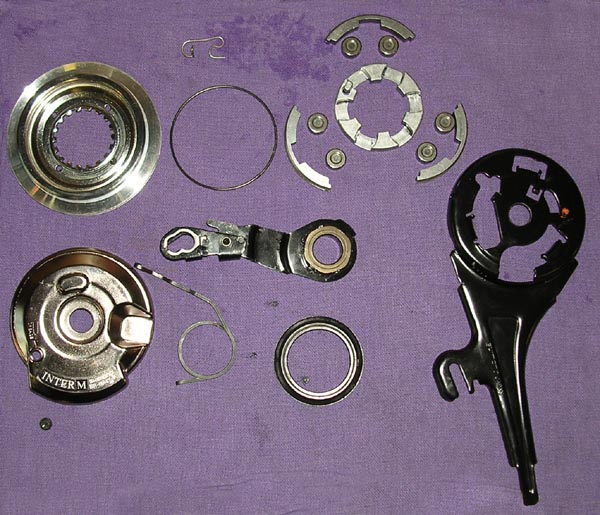
This bike is equipped with a roller brake. It's almost like a drum brake that's actuated with a hexagonal nut looking thing that 6 rollers rotate around pushing pressure plates against the inside diameter of the braking surface.

There is one nut that holds the assembly to the hub shell. Once that's removed, the whole brake comes off.


We now have access to the wench flats of the cone and lock-nut. These can be completely removed...


... And the internals are free of the hub shell!


The dirty, greasy parts get a nice hot bath in the parts washer. I usually let the cartridge sit for an hour or so to allow the old grease to break down.


Here is an exploded view after the parts are all cleaned.


Since when has Shimano made ice cream topping???


Must be "Blue Razzzberry."


The cartridge gets soaked till it's good and saturated. I usually wait till the bubbles subside.


Allow the excess to drain.


Clean the inside of the hub shell.


Apply grease to the bearings and clutch rollers. I also inject 3cc or 4cc of the special Shimano oil (ice cream topping) between the gears before putting everything back together.


Reinsert the cartridge and wipe off the excess grease.


Re-adjust bearing on the non-drive side till there is no play.


Install dust seal.


Grease back of dust shield and reinstall.


Grease the back of the cog and reinstall (We have had issues with these making noise, and grease seems to solve the problem).


Realign red dots with red, yellow dots with yellow...


... And rotate lock-ring to lock the shift mechanism in place.


It's good practice to lubricate the roller brake regularly. Squirt some special roller brake grease in the grease port.


Loosely install the roller brake. Tighten the drive side axle nut, align the reaction arm, then tighten the roller brake nut to fix it to the hub.


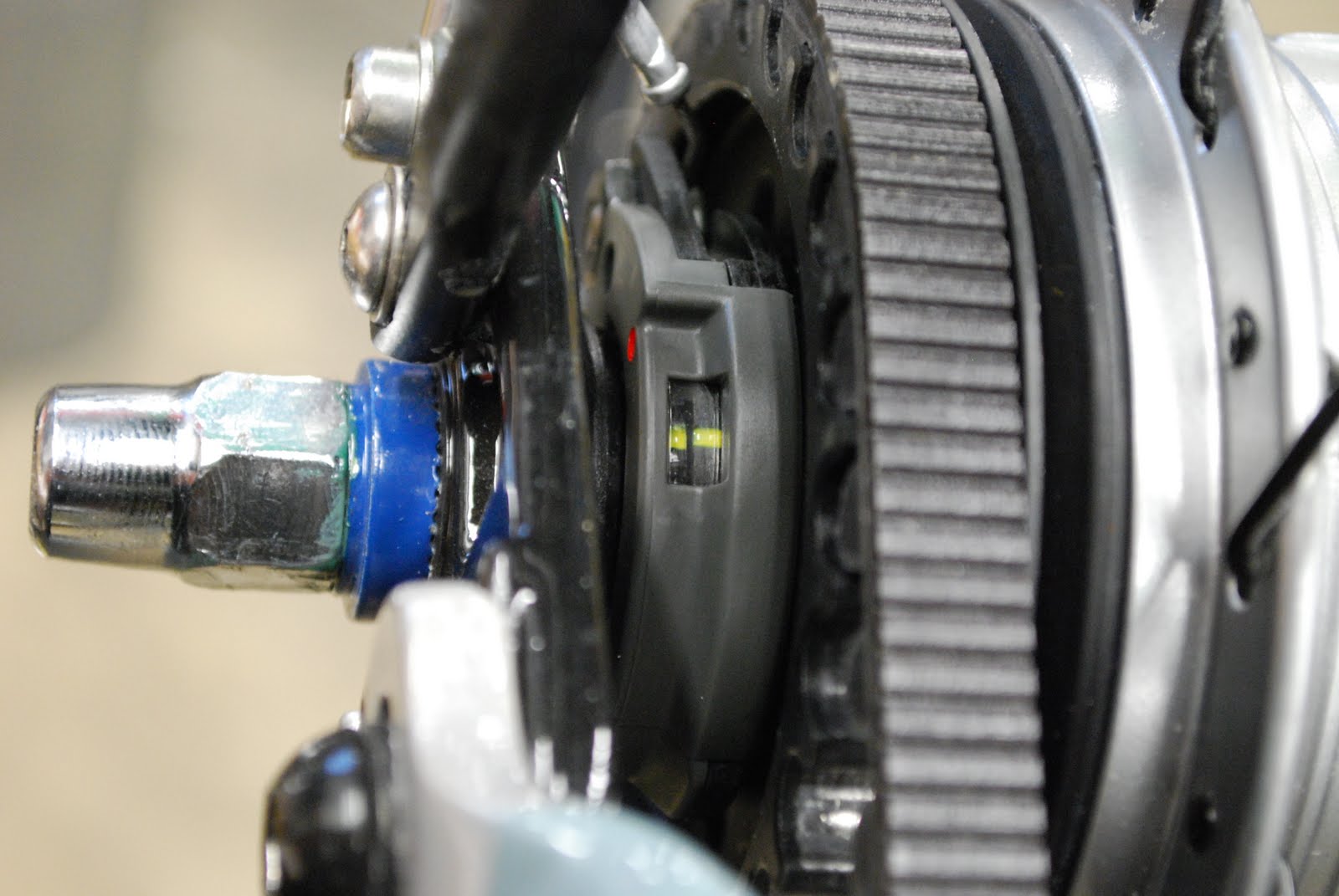
Seat the axle in the dropouts and fasten both axle nuts. Align belt if applicable. Check all the gears to make sure there are still 8 of them. If there aren't as many as when you started, something went wrong. Shift into 4th gear and use cable tension to align the two yellow marks in the window.

After performing this service, the hub felt like it shifted faster and more crisply, especially in the extreme cold. One of our year-round commuting employees, Ben, who uses the same hub described the overhaul to make the shifting "less gummy and more direct. It gives me all of it," he concluded. I'm not really sure what that last part means, but it sounds pretty positive.

Monday, January 10, 2011

Last Month for Winter Overhaul Special

We're a third of the way through January, which can only mean one thing: The Winter Overhaul Special is slowly coming to an end! If you haven’t yet, you can book your appointment online at http://freewheelbike.com/articles/schedule-an-appointment-pg490.htm , or call one of our two locations:

West Bank: 612.339.2235

Midtown Bike Center: 612.238.4447

Also, don’t forget we offer FREE PICKUP AND DELIVERY with every winter overhaul special within 15 miles – Just make sure to book your online appointment through Freewheel Mobile when given location choices. You can bring your bike in or make an appointment for in-store drop-off/Mobile pick-up through January 31st!

Wednesday, January 5, 2011

The Big Blue S

Earlier this season one of our customers brought in a Shimano RS10 wheel that had begun doing this:

More precisely, that was happening on every one of the push spokes on the non-drive side. Push spokes, non-drive side. Nope, not a disc brake, it's a road wheel. It was rather mysterious and we immediately suspected a conspiracy. It's the Martians, we all thought, they're at it again.

Providentially, Andrew the Shimano Rep happened to be at the shop at that very moment. He was scheduled to sabotage all the bikes in our showroom with Avid Elixir brakes and was between acts of treachery when our poor customer came in. It was one of those rare moments when you truly see that the Big Blue S is made up of a bunch of people who have souls.

First, the wheels were RS10's. They weren't Shimano's top-of-the-line offerings, they were more or less mid-level units designed to hold up rather than be impressive on the gram scale. Think 105 but wearing jeans and a sweater instead of a suit.

Second, the wheel was right on the sunset of its warranty. In fact the sun had already gone down a bit by our records, and furthermore, the wheels were already a model year old when the customer bought them. In other words, Shimano had no obligation to our customer.

The customer was taking it all in stride as we covered these bases, even though it was going to be a few hundred bucks he didn't necessarily want to spend right then. We were going to cut him a deal on a new set of wheels, but Andrew the Shimano Rep beat us to the punch.

"Ooo, 'eck. Bloomin' great cracks in that'n, wot? Crack's woid enough to droive a canoe innit, or I'm a monkey's bum. Not even SP41 grease'l shift that."

Roughly translated, he said "Call the inside rep and tell him what happened. I think we can work something out because this is truly an abnormal situation."

So I called the inside rep. To make a long story short, The Big Blue S made right by our customer, and then some. Our part of the bargain was that we had to send in the offending wheelset so that their engineers could gather around it, poke at it, learn from their mistakes, and leak those mistakes (cleverly disguised as trade secrets) to Chinese companies.

Shimano's part of the bargain was to replace the wheels. Remember the out-of-warranty part? You'd think they would offer a crash replacement, but no, they offered to replace the wheels. And instead of another set of RS20 wheels (or R500, or whatever they replaced the RS10's with), they promised a set of Ultegra WH-6600 Tubeless wheels! And they didn't even ask for his soul, first-born, DNA sample, or SSN in exchange for them!

That's pretty impressive. The phantom valve stem means that they're tubeless compatible if he ever wants to get some Hutchinson tires and go that route, and they're roughly 200 grams lighter than his old set of wheels. The fellow at The Big Blue S said they're "pretty sturdy" and do not have a weight restriction, so we're hopeful that they will last a while.

Bottom line: kudos to Shimano for making our customer's day/week/month! And for getting rid of Dual Control and Rapid Rise.